
- This event has passed.
Nature as Neighbour: Ecological Grief
12th May: 5:00 pm - 7:00 pm BST
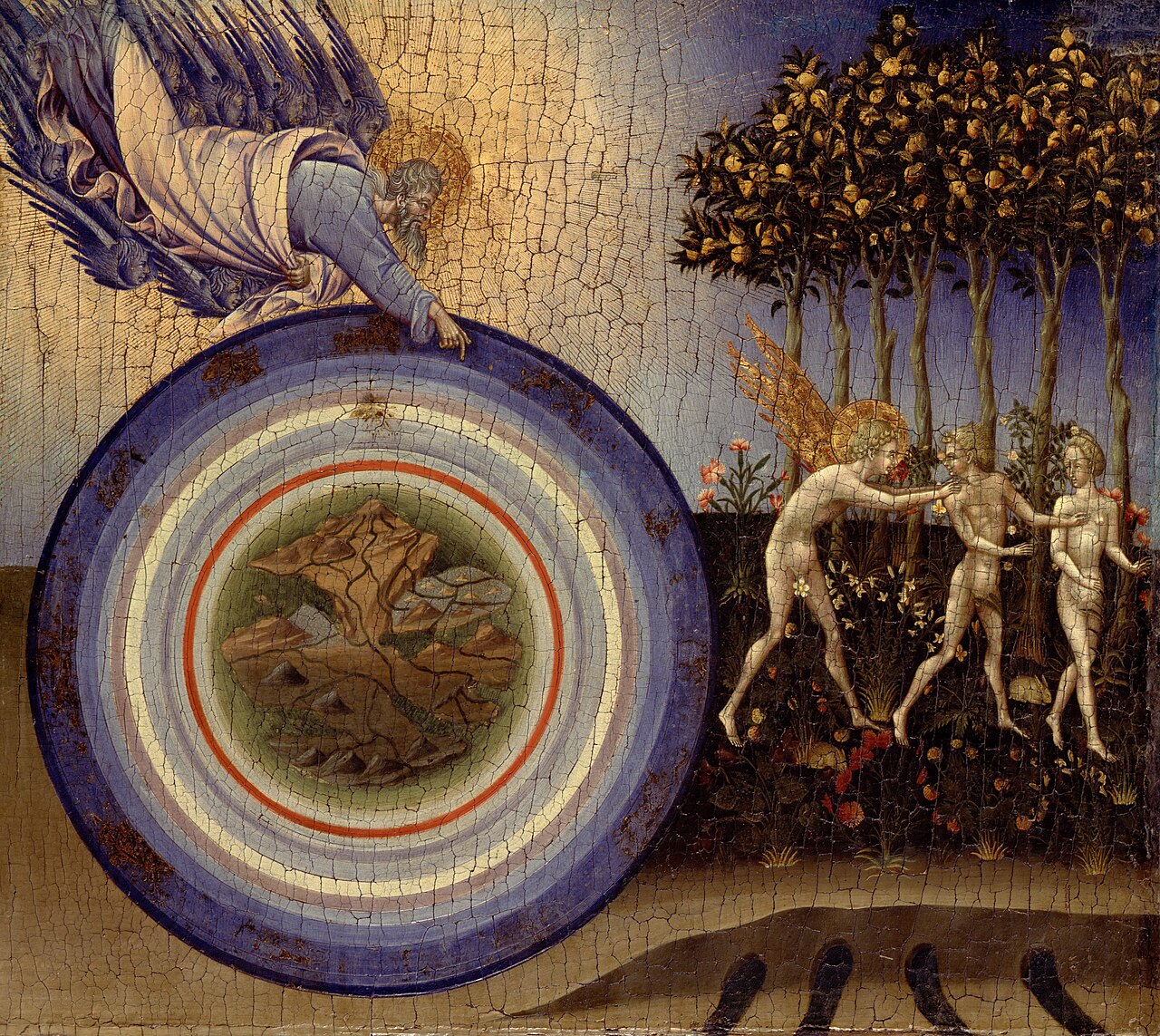
Giovanni di Paolo, The Creation of the World and the Expulsion from Paradise (Met)
This seminar series brings together emerging scholars of historical ecologies, placing them in conversation to reflect on the relationship humanity has and had with the natural world. By tracing how human–environment relations have been imagined, governed, and lived in the past, the seminar foregrounds nature not as a distant backdrop but as a proximate and entangled neighbour. Responding to one another and in dialogue with attendees, this seminar will workshop how historical perspectives can inform present-day responses to the climate and natural world, offering critical insights into environmental-stewardship, -responsibility, -coexistence, and environmentally-just futures.
Convened by Nidanu O’Shea, Wolfson, and Dr John Angus Macaulay, Blackfriars, the theme of this term’s seminar is ‘Ecological Grief’.
The seminar will take place at 5pm Tuesday the 12th of May in the Aula of Blackfriars Hall and will be followed by a reception. Open to everyone and registration is required, please follow the link
speakers
Xinyue Liu,
Ecological Grief and Speculative Future
It is 2125. Eve is an exhausted but dedicated bureaucrat at the Bureau of Environmental Imaging and Memory Analysis. She works for the Special Office of the Haunted, Cinema of Ecological Grief Division. She is pressed to be sufficiently haunted by ecological grief—the irreparable sorrow felt in response to devastated species, places, and landscapes. Eve’s responsibility is to inventory and perform memories entrusted to her by snowdrop plants, beluga whales, and river dolphins.
This presentation outlines my doctoral practice-led thesis project, which explores ecological grief through my fieldwork at the Institute of Hydrobiology, where the Yangtze River dolphin went extinct. Drawing on ecofeminist critique, Black hauntologies, and critical fabulation, this project critically examines ecological grief both as an essential emotion in conservation and as an immense emotional burden placed on those who experience it. Through the form of fiction, this duality is explored, along with the bureau itself, which I am developing as a creative strategy for working with endangered nature.
Xinyue Liu is an interdisciplinary artist and researcher in fine art, and a Clarendon Scholar with a DPhil in Fine Art from the University of Oxford. She holds a permanent Research Fellowship at the Rural Lab, Glasgow School of Art, contributing to an expansive portfolio in regenerative creative practice across Scotland’s Highlands and Islands. She works with film, text, movement, and installation. Her research focuses on the intersection between contemporary visual culture and ecological grief. She is particularly motivated by reframing grief as a resource for sustained ecological remembrance. Her driving question is how speculative art can resurface connections with lost memories and species from a particular landscape.
Electra Perivolaris,
Dialogues, Encounters, and Entanglements: Developing a compositional practice which reimagines and examines relationships between humans and nature
This paper outlines my artistic research into composition as a means of exploring human–nature interconnection. Drawing on eco-musicology, anthropology, and cultural geography, I critique anthropocentric perspectives and pastoral traditions, proposing a “post-pastoral” approach that embraces ecological complexity and tension. Through composition and community-based practice, I investigate how music can express interwoven relationships between human and more-than-human worlds. The research emphasises listening as an immersive, embodied practice and foregrounds sustainable, participatory creativity. It positions composition as a collaborative ecological process that fosters empathy, challenges binary thinking, and highlights the interconnectedness of all life.
Electra Perivolaris has been described as a “Classical Star of the Future” by BBC Introducing, and “a razor-sharp musical imagination’ by The Telegraph. A graduate of the Royal Conservatoire of Scotland (BMus Hons) and the Royal Academy of Music (MMus, DipRAM, LRAM), Electra was a Royal Philharmonic Society Composer, the inaugural Young Classical Artists Trust Composer Fellow and a PRS Foundation Classical:NEXT Fellow. Recent commissions have included works for the BBC Concert Orchestra, Orchestra of the Age of Enlightenment, BBC Singers and the Hebrides Ensemble.
Riley Faulds,
‘Deep Bouvard’: Ecopoetry as a Method for Making Abstract Environmental Philosophy Materially Useful
Many threads of environmental philosophy, like Arne Naess’ ‘deep ecology,’ have been influential across academic disciplines. But how useful can they be in the actual management of existentially threatened material ecologies—for a farmer, gardener, conservationist or other person responsible for the use or stewardship of land or ecosystems? My ‘Deep Bouvard’ project seeks to investigate this question via innovative ecopoetry, and to simultaneously interrogate the specific relevance and utility of the key principles of deep ecology for a place in Bindjareb Country, in what we now call Western Australia. In the poems, I confront the ethically complex grief of caring for and mourning an ecology in whose degradation I and my colonist ancestors are deeply implicated—and make the argument that poetry is uniquely suited to such an interrogation.
Last week, Riley Faulds put another notebook through the washing machine. He would be a much more prolific writer and successful scholar if he didn’t keep doing this. Riley grew up in Western Australia, and worked as an environmental scientist alongside his Bachelor’s in Agricultural Science and English. He is currently working on a DPhil developing ‘weedy reading,’ a method of literary analysis he’s applying to the poetry of agriculture and gardening of Australia, southern Africa and the Caribbean. Despite the literally hundreds of pages lost to the soapy waters over the years, he’s had poetry and reviews published in many of Australia’s best journals and prize lists.
Venue: Blackfriars Hall -
St Giles
Oxford,
OX1 3LY
United Kingdom
Contact:
Las Casas Institute
lascasas@bfriars.ox.ac.uk