
- This event has passed.
Nature as Neighbour: Past Entanglements and Present Challenges
21st February: 2:00 pm - 5:00 pm GMT
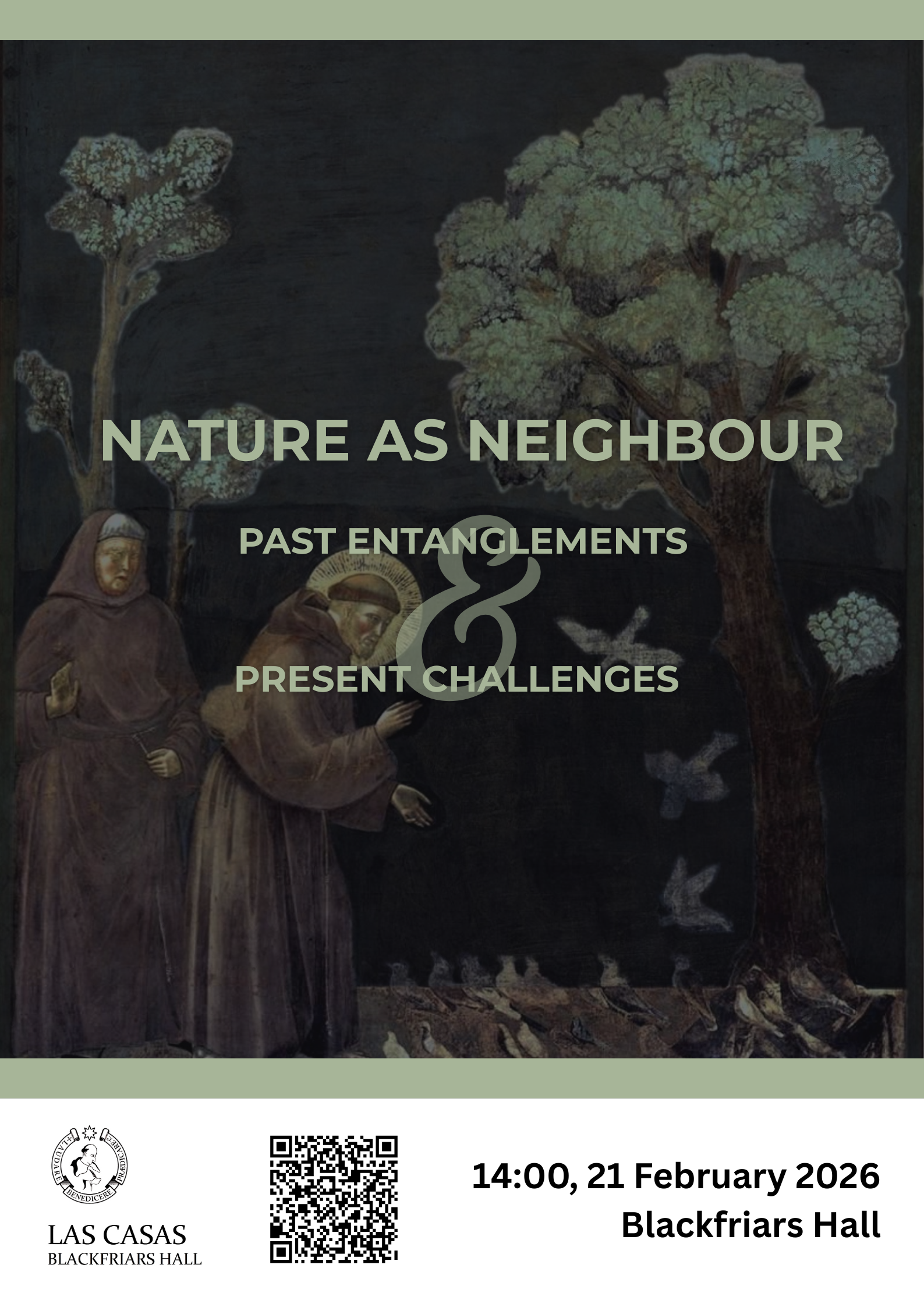
This seminar brings together emerging scholars of historical ecologies, placing them in conversation to reflect on the relationship humanity has and had with the natural world. By tracing how human–environment relations have been imagined, governed, and lived in the past, the seminar foregrounds nature not as a distant backdrop but as a proximate and entangled neighbour. Responding to one another and in dialogue with attendees, this seminar will workshop how historical perspectives can inform present-day responses to the climate and natural world, offering critical insights into environmental-stewardship, -responsibility, -coexistence, and environmentally-just futures.
The seminar will be held at 2pm Saturday the 21st of February, at Blackfriars Hall. A reception will follow. This event is open to everyone, registration is required to attend.
This seminar is co-convened by Nidanu O’Shea and John Angus Macaulay.
speakers
Andrew McNey – A Green Desert? Interrogating Reciprocity in the Late Antique Negev
In the late fourth century a complex irrigation regime swept across the Negev desert in response to opportunities afforded by high value plants. This talk seeks to interrogate the possibility of a reciprocal relationship between the farmers of the late antique Negev and their environment. Agronomical research suggests that growing plants in a desert may have a beneficial impact on soil health and biodiversity. However, ecologists posit that the exponential extraction of natural resources created fragility in a system that was coaxed into rigidity. This talk will probe these two cases through the lens of landscape archaeology.
Andrew is currently studying for the DPhil in History at Reuben College, Oxford. His research seeks to explore transdisciplinary approaches to narratives of resilience in rural communities of the eastern Mediterranean during Late Antiquity. He has worked as an excavator at the sites of Tel Azekah and Yavneh and as a Supervisor at Ancient Corinth. As a research assistant at the University of Cambridge he documented archaeobotanical material from the site of Yotvata. He was recently appointed Stipendiary Lecturer in History at Trinity College.
Pablo Scheffer – The Sagas of Icelanders and Climatic Change
The forty-or-so texts known as the Sagas of Icelanders were written in the thirteenth and fourteenth centuries, and describe the lives of Iceland’s first settlers a few hundred years earlier. In the intervening period, the island’s environment changed dramatically. Forests were felled; native species were extirpated; landscapes were transformed by erosion. The climate, meanwhile, became both colder and more unpredictable. In my paper I’ll begin to consider if and how the sagas remember these changes, ultimately to ask a larger question: what did medieval Icelanders make of the fact that the world around them was becoming a more hostile place?
Pablo Scheffer is a second year DPhil student in Old Norse. His research – which is co-funded by the AHRC, the Clarendon Fund and Magdalen College – sits at the intersection of literary studies and environmental history, exploring how the Sagas of Icelanders grapple with the harshness and unpredictability of the Icelandic environment. Before starting his DPhil, he spent three years at the Times Literary Supplement, where he remains the consultant editor for medieval history and literature.
Richards Chang Yui Cheong – When the Waters Turn Buddhist: Ecological Histories of Conversion in Kinnaur
Situated along the Old Hindustan–Tibet trade routes in the Western Himalayas, Kinnaur has long been a zone where Buddhist, Hindu, and pre-Buddhist traditions meet. This paper examines Buddhist conversion in Kinnaur through its ecological dimensions, focusing on water management and the ritual “taming” of klu, serpent spirits associated with wild waters. Drawing on Tibetan historiographical texts and contemporary ethnography, it argues that conversion in the Western Himalayas was enacted not only through doctrinal changes or royal patronages, but also through practical engagements with landscape and environment. By situating Kinnaur as a key contact zone during the 10th–11th centuries, the study reframes religious conversion as an ongoing ecological process that continues to shape Buddhist practice and community life today.
Richards Chang Yui Cheong is a DPhil candidate in Tibetan & Himalayan Studies at St Antony’s College, the University of Oxford. He employs historical and anthropological approaches to examine processes of place-making and identity formation in the Western Himalayas. His doctoral research focuses on the religious history of Kinnaur (Tib. Khu nu), analysing it as a contact zone between the Tibetosphere and Indosphere during the early phyi dar period. He completed his MPhil in Tibetan and Himalayan Studies at Wolfson College, Oxford, where his thesis examined the place-creation history of Mtsho Padma (Rewalsar).
Venue: Blackfriars Hall -
St Giles
Oxford,
OX1 3LY
United Kingdom
Array
(
[lat] => 51.756248
[lng] => -1.259881
)
Contact:
Las Casas Institute
lascasas@bfriars.ox.ac.uk